Access The Price Is Wrong — our two-year investigation into the gun industry's widespread economic monitoring and discipline around prices, but not public safety.
LEARN MORE

In April 2026, Guns Down America analyzed campaign contributions from leading companies, trade associations and interest groups associated with the firearms industry. This report is based on Federal Elections Commissions data on political contributions made in the 2026 election cycle through the end of February.
READ ON
In April 2026, Guns Down America analyzed campaign contributions from leading companies, trade associations and interest groups associated with the firearms industry. This report is based on Federal Elections Commissions data on political contributions made in the 2026 election cycle through the end of February (the most recent processed data available). It covers contributions from the following entities:
Corporate PACs
Trade Association/Interest Group PACs
Axon Enterprise manufactures weapons and defense technology including TASER brand tasers. While traditional firearms manufacturers like Smith & Wesson and hardline interest groups like Gun Owners of America give 100% of their cash to Republicans, Axon was an exception. The TASER maker split its $68,500 in contributions nearly equally to each party ($34,500 to Republicans; $34,000 to Democrats).
Axon launched its PAC as it works to build support for the "Innovate Less Lethal to De-Escalate Tax Modernization Act" in order to exempt its marquee TASER product from being regulated and taxed under federal firearms law. More about their recent lobbying activity can be found in this report.
The 2026 data shows that the NSSF reported more than $24,000 of "in-kind" expenses to support fundraising events for eight distinct candidates.
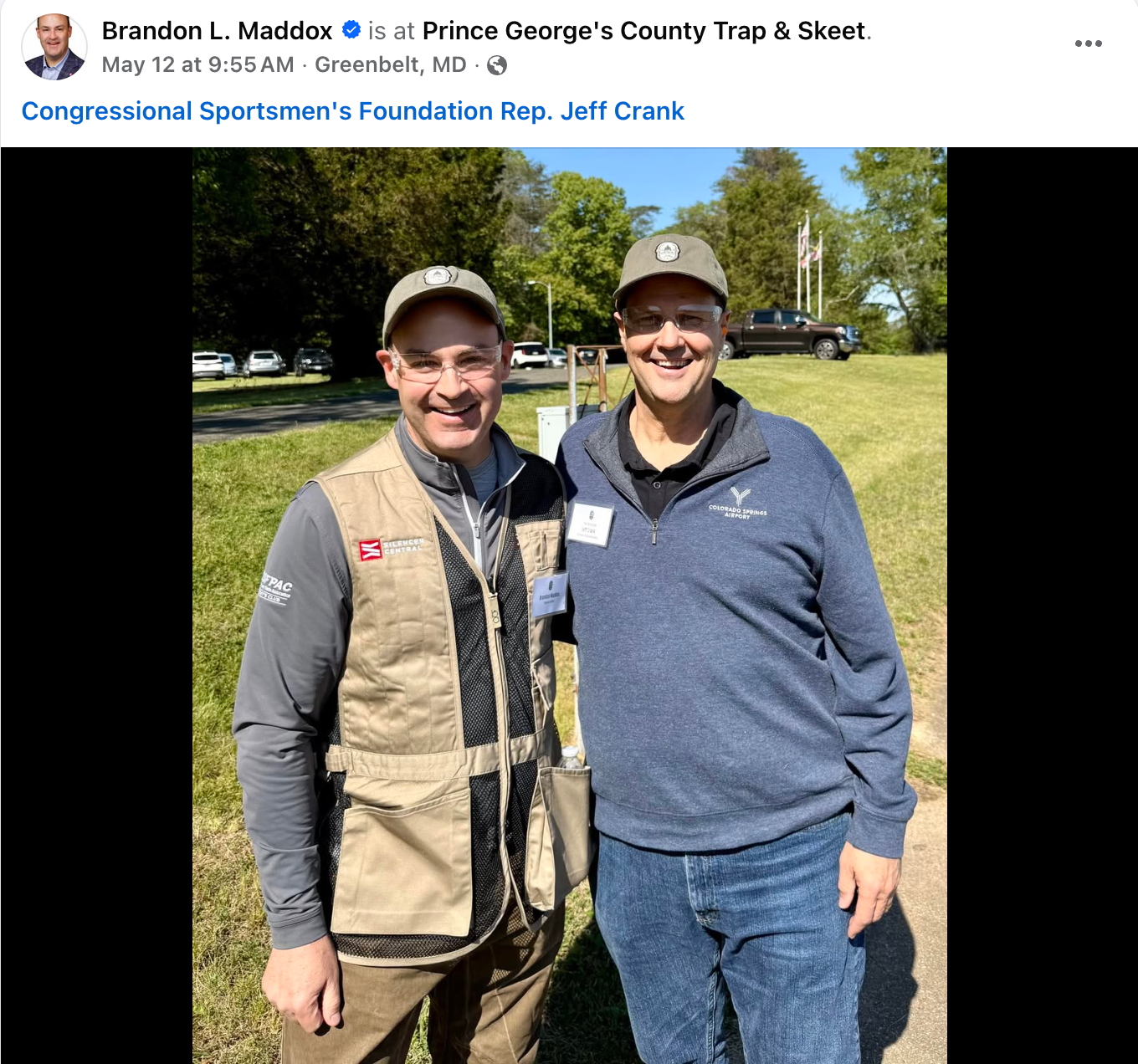
Many of these events were held at Prince George's Trap & Skeet Center, a public sporting center in Maryland. Fundraisers for Reps. Jake Ellzey, Dan Newhouse, Brian Babin, Celeste Maloy, Andy Harris, and G.T. Thompson were all held here.
On the Facebook page for Prince George's Trap & Skeet Center, politicians can be seen spending quality time with gun industry executives.
More than $875,000 in contributions flowed directly from industry PACs to congressional campaign committees.
The rest of the contributions—totaling around $630,000—were primarily distributed among party organizations, joint fundraising committees and leadership PACs. The next largest share went to party organizations such as the National Republican Congressional Committee, which supports House GOP candidates, followed by joint fundraising committees, which divvy up funds among multiple campaigns and/or party accounts.
The industry also utilizes Joint Fundraising Committees (JFCs) and Leadership PACs as money-routing mechanisms where the ultimate beneficiary and influence is harder to track.
Gun industry groups poured $155,500 into JFCs, with more than half ($83,000) going directly into the Johnson Leadership Fund controlled by House Speaker Mike Johnson. Another $76,000 was distributed to Republican Leadership PACs, topped by Senate Majority Leader John Thune’s Heartland Values PAC ($15,000) and Senate Majority Whip John Barrasso’s Common Values PAC ($10,000).
Gun industry campaign spending has topped more than $1.5 million so far this cycle, dominated by giving from the NSSF and NRA. NSSF, the main trade association for firearms and ammunition manufacturers and dealers, was responsible for nearly half of the industry’s total contributions, spending nearly $725,000 so far this cycle. The NRA was responsible for the bulk of the remainder, with more than $580,000 in spending. The largest corporate spender was Olin Corp., a manufacturer of ammunition as well as a variety of chemical products, with $73,000 in total contributions.
Gun industry players donated almost exclusively to Republicans, with the notable exception of Taser-maker Axon. All of the contributions from NSSF and the NRA went to Republican candidates, aside from a $1,000 donation from NSSF to Republican-turned-Independent Rep. Kevin Kiley, of California. The National Association for Gun Rights, Smith & Wesson and Gun Owners of America were entirely one-sided in their giving, while Olin and Sig Sauer made only token contributions to Democrats. However, taser manufacturer Axon stood out as a bipartisan exception. The company, which has been lobbying Congress to exempt its marquee product from being regulated as a firearm under federal law, split its contributions nearly evenly between Democrats and Republicans.
House candidates and campaign committees received approximately two-thirds of the industry’s total campaign spending. More than $1 million in contributions flowed into the campaigns of House candidates, leadership PACs and party committees, compared to less than a quarter-million targeted toward Senate races. There are significantly more House than Senate races this year.
More than half of total donations were sent directly to campaign committees, with the rest primarily distributed among party organizations, joint fundraising committees and leadership PACs. More than $875,000 in contributions flowed directly from industry PACs to congressional campaign committees in specific districts. The next largest share went to party organizations such as the National Republican Congressional Committee, which supports House GOP candidates, followed by joint fundraising committees, which divvy up funds among multiple campaigns and/or party accounts. Industry donors also gave substantially to leadership political action committees, vehicles used by members of Congress to raise money for their allies.
Axon launched its PAC in October 2024, and it began donating to campaigns this cycle. So far, it has given $68,500 to 34 House members and one leadership political action committee. Total contributions were split nearly evenly between Democrats and Republicans.
Members of the House Ways and Means Committee, which has jurisdiction over federal tax law, were the largest recipients of Axon donations, with a total of $19,500 in contributions to 10 committee members. The committee also had jurisdiction over one of Axon’s top legislative priorities this year, the “Innovate Less Lethal to De-Escalate Tax Modernization Act,” which would exempt products like Axon’s marquee TASER self-defense weapon from being subjected to the federal firearms tax.
The next largest pool of contributions went to members of the Judiciary Committee, which oversees federal law enforcement agencies that are major buyers of Axon’s products. Judiciary Committee members’ campaigns received a total of $15,500, and Axon donated another $1,500 to the Buckeye Liberty Political Action Committee, the leadership PAC controlled by Judiciary Chairman Jim Jordan, of Ohio. The Judiciary Committee also was responsible for another key Axon priority, the “Law-Enforcement Innovate to De-Escalate Act,” which passed the House in February after the tax exemption legislation was incorporated into it.
The PAC gave to candidates in 19 states, led by California and Ohio (home to Judiciary Committee Chairman Jim Jordan).
Axon’s primary corporate headquarters are located in the Phoenix, Arizona, metropolitan area, and it leases locations in nine states, according to its most recent 10-K. Axon’s PAC gave $1,500 to Rep. Greg Stanton, a Democrat who represents a Phoenix-area district; he was the only Arizona representative to receive support. Axon’s primary business address in Scottdale, Arizona, is represented by Rep. David Schweikert, a Republican who is retiring at the end of his term.
Outside of its home state, the company’s largest facilities are in Washington and Massachusetts, two states notably absent from the list of supported lawmakers. In addition to its corporate headquarters in Scottsdale, Arizona, Axon has U.S. offices in Seattle, Boston, San Francisco and Denver.
In addition to reporting the money they give directly to political organizations, corporate PACs are required to disclose their “in-kind” expenses that benefit a candidate for office, typically by hosting fundraisers on their behalf.
According to its most recent filings, NSSF has reported more than $24,000 in in-kind expenses, benefitting eight candidates. Most of the expenses have gone to the Prince George's Trap & Skeet Center in Glenn Dale, Maryland, just outside of Washington, DC.
Other expenses were associated with an event benefitting Rep. John Joyce of Pennsylvania at the XCAL Shooting Sports & Fitness in Ashburn, Va., another Washington suburb.
The only NSSF-sponsored event outside the DC area took place at Orvis Hill Country Shooting Grounds, Fairfield, Pennsylvania, to benefit Nebraska Senator Deb Fisher.
In addition to giving directly to campaigns, corporate PACs also have access to several other types of committees through which they can demonstrate their support for lawmakers or political candidates.
The most common among these are Leadership PACs, which members of Congress can use to donate to political allies or pay for certain travel and entertainment expenses, and Joint Fundraising Committees, which can raise larger sums of money to be divided among campaigns, parties and other groups.
So far this cycle, gun industry groups have given $155,500 to Joint Fundraising Committees. More than half of that total—including $50,000 from NSSF and $30,000 from the NRA—went to the Johnson Leadership Fund, controlled by House Speaker Mike Johnson of Louisiana.
House Majority Leader Steve Scalise, another Louisianan, was the next largest beneficiary of industry contributions to his JFC, followed by House Judiciary Committee Chairman Jim Jordan.
Republican Leadership PACs and one unauthorized PAC received just shy of $76,000 from the gun industry so far this cycle.
The top recipient was Senate Majority Leader John Thune’s Heartland Values PAC, with $15,000 in contributions, followed by Sen. John Barasso of Wyoming, the Majority Whip, with $10,000 in industry contributions to his Common Values PAC.
Rep. Ryan Zinke, the Montana Republican and former Interior Secretary, was linked to two PACs that have received industry support so far this cycle. His leadership PAC, the Commander Zinke Leadership Fund, received $2,500 from the NSSF. Zinke, a former Navy SEAL, is also listed as the “commander” of Supporting Electing Americas Leaders (SEAL) PAC, which the FEC designates as an “unauthorized” PAC. SEAL PAC was the subject of an FEC inquiry over account discrepancies in 2017, according to Politico, and Roll Call reported in 2022 that the PAC continued to face “ethical questions.”


