ANALYSIS
An analysis of gun industry economic data, court records, earnings call transcripts, and publicly available retailer agreements revealed that the gun industry uses a practice that resembles resale price maintenance (RPM) to enforce a price floor for guns in America. This is also known as price fixing.
Retailers used their market power to strong arm manufacturers into artificially inflating gun prices. This business practice exploits consumers, reduces market competition that could lead to safety innovations, and disproves the gun industry’s public claims that it has no ability to track supply chains to curb crime guns.
Continue reading for an overview of findings, or access the full report and supporting materials below.
DOWNLOAD REPORT ↓FAST FACTS
- Resale price maintenance is widely used in the gun industry, setting a price floor for firearms
- Manufacturers, distributors, retailers, and trade associations share information and resources to enforce price floors.
- Independent retailers believe they operate on a level playing field with big box retailers, but, in fact, they are disproportionately impacted by enforcement that funnels economic benefits to bigger competitors on an unequal and disproportional basis.
- Gun manufacturers claim they lack the tools to prevent the diversion of firearms to illegal markets, while boasting to investors about their total visibility into retail inventory and absolute price discipline.
“...it's fun to sell because you don't have to worry about price.”
Michael Fifer
Sturm Ruger CEO,
Q4 2013 Earnings Call
HOW RPM WORKS IN PRACTICE
- Uniform Distributor-Retailer Price Policies (UDRPs) or Minimum Transfer Prices (MTPs): A pricing policy at the distributor level that sets the price at which distributors can sell merchandise to retailers.
- Minimum Advertised Price Policies (MAPs): In theory, a restriction that prevents retailers from advertising prices lower than those set by manufacturers. In practice, the de facto resale price of guns in America.
IN THEIR WORDS
Gun industry executives have publicly described their pricing practices in earnings calls, interviews, and affidavits.

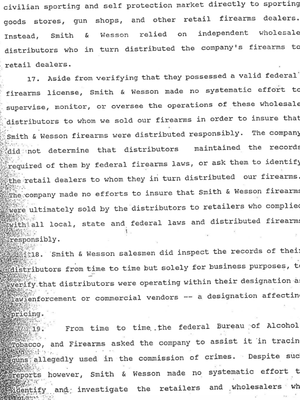
While Smith & Wesson never bothered to check on whether gun dealers were selling its guns legally, he said, the company was more than willing to get tough with dealers who tried to sell guns at too low a price. "God knows we did that enough," he said.
Robert Haas
Former VP, Smith & Wesson
Deposition in Hamilton v. Accu-Tek
MAP is "that minimum that they're [manufactuers] asking you to sell it for."
Brandon Roper
Vice President, National Association of Sporting Goods Wholesalers (NASGW)
October 2025 NASGW webinar
" Whenever we had a price adjustment, we make them whole…So again, we expect a lot from our distributors, but in turn, they've come to expect a lot from Ruger. So it's really a 2-way street.”
Michael Fifer
CEO, Sturm Ruger
Q2 2022 Sturm Ruger & Company Inc Earnings Call